Discover how Aidoc’s AI platform offers seamless end-to-end integration into a facility’s existing IT infrastructure enabling implementation of AI at scale.
Discover how Aidoc’s AI platform offers seamless end-to-end integration into a facility’s existing IT infrastructure enabling implementation of AI at scale.
Insights from RSNA 2025: Imaging the Individual, Efficiency as Mission-Critical and Meeting the AI Moment in Radiology
Table of Contents
The Aidoc team just wrapped our week at RSNA — a week filled with valuable customer touchpoints, a demand for real, proven solutions for radiologist efficiency and some wild weather sprinkled in to make RSNA even more memorable than usual.
Imaging the Individual
The time for whole-patient health in radiology has arrived. Whether it be demand for priors in reporting and workflows or patient context derived from electronic health record (EHR) data, imaging must be able to connect the dots to look at patients holistically and AI has the power to bring these inputs together in an actionable way.
At Aidoc’s European AI Advisory Board meeting, we gathered radiology experts from leading healthcare organizations throughout the UK and EU who put it best — the potential for AI to help derive patient insights, offering a richer way of looking at a patient that factors in images, reports, clinical context and guidelines to drive more informed action, underscoring the approach we’re taking with our CARE™ foundation model.
And incidentals were a huge topic; the value of looking more holistically at patient cases, beyond the suspected findings. We helped one of our customers flag 10,000 incidental findings in one year. Our new acute abdomen CT solution, built on our foundation model, ensures our customers are equipped to uncover the hidden indications that exist within the anatomy.
A Demand for Proven AI as the Standard to Scale
The rallying cry was there: It’s time to bring much-needed help to combat the shortage of radiologists. But radiologists will not settle for poor-performing AI solutions that lack evidence and experience. They are challenging the “promised” — rightfully so — and demanding the “proven”.
When scaling AI, one customer told us“we want an AI deployment that makes adding things easier”. This means single integrations, a unified user experience and an experienced partner who can help radiology departments light up AI solutions in weeks, not months. Many attendees expressed caution when seeing the many detection “solutions” on the show floor, especially where there were noregulatory clearances, clinical evidence or real adoption.
We were also excited to announce new partnerships with Quibim and NVIDIA MONAI that help health systems respond to the needs of their patient populations and democratize AI innovation.
Transparency and Trust Go Hand in Hand
As one of our customers put it, “we have to embrace the ‘human-machine collaboration’”, in regards to the adoption of AI. But trust is necessary to embrace it, and trust only comes with transparency. This year at RSNA, it was clear that radiologists want to understand the breadth and depth of how AI models are trained, they want to see advertised AI solution performance mirrored in their real-life usage.
The message was clear: In a sea of foundation models, the datasets used to train must be robust, diverse and run both wide and deep. It was eye-opening to discuss our CARE™ foundational model with them, which is trained on tens of millions of patient journeys, and to also show our new AI-Powered Analytics, where radiologists can see AI performance, submit feedback, see the impact of AI-identified incidental findings, all with a level of transparency they haven’t experienced before.
The Power of Clinical Insights: Aidoc Customers in the Spotlight
At RSNA 2025, Aidoc customers released new clinical studies that highlight the life-changing impact Aidoc’s aiOS™ is having on clinicians and patients alike.
Here are some of the highlights:
University of Miami Health System (UHealth) displayed their innovative use of AI to improve patient outcomes and demonstrate ROI, realizing $220,000 per year in revenue on incidental pulmonary embolisms (PEs) alone.1
Jefferson Einstein shared that 14.3% (6/42) of patients identified through the coronary artery calcification workflow were escalated from additional cardiac testing to diagnostic left heart catheterizations, leading to two revascularizations (one PCI and one CABG).2
SSM Health St. Louis University Hospital shared results comparing AI solutions: 99.2% sensitivity for flagging intracranial hemorrhage (ICH), compared to conventional AI’s 68.7% sensitivity.3
Yale New Haven Health shared their 50%+improvement in PE time-to-diagnosis, nearly halving hospital and ICU LoS over 2 years.4
Unveiling Aidoc’s Inaugural Hall of Fame Inductees
It wouldn’t be RSNA if we didn’t take time to celebrate the innovators who continue to blaze new trails in radiology practice. On Monday evening, we brought together hundreds of Aidocees and industry leaders to share our vision of constructing the future of radiology.
This special event included the unveiling of Aidoc’s Radiology Hall of Fame, honoring the pioneers whose foundation we now build upon.
The inaugural inductees included:
WellSpan Health
Cedars-Sinai Medical Center
Mount Sinai Health System
University of Miami Health System
Yale New Haven Health
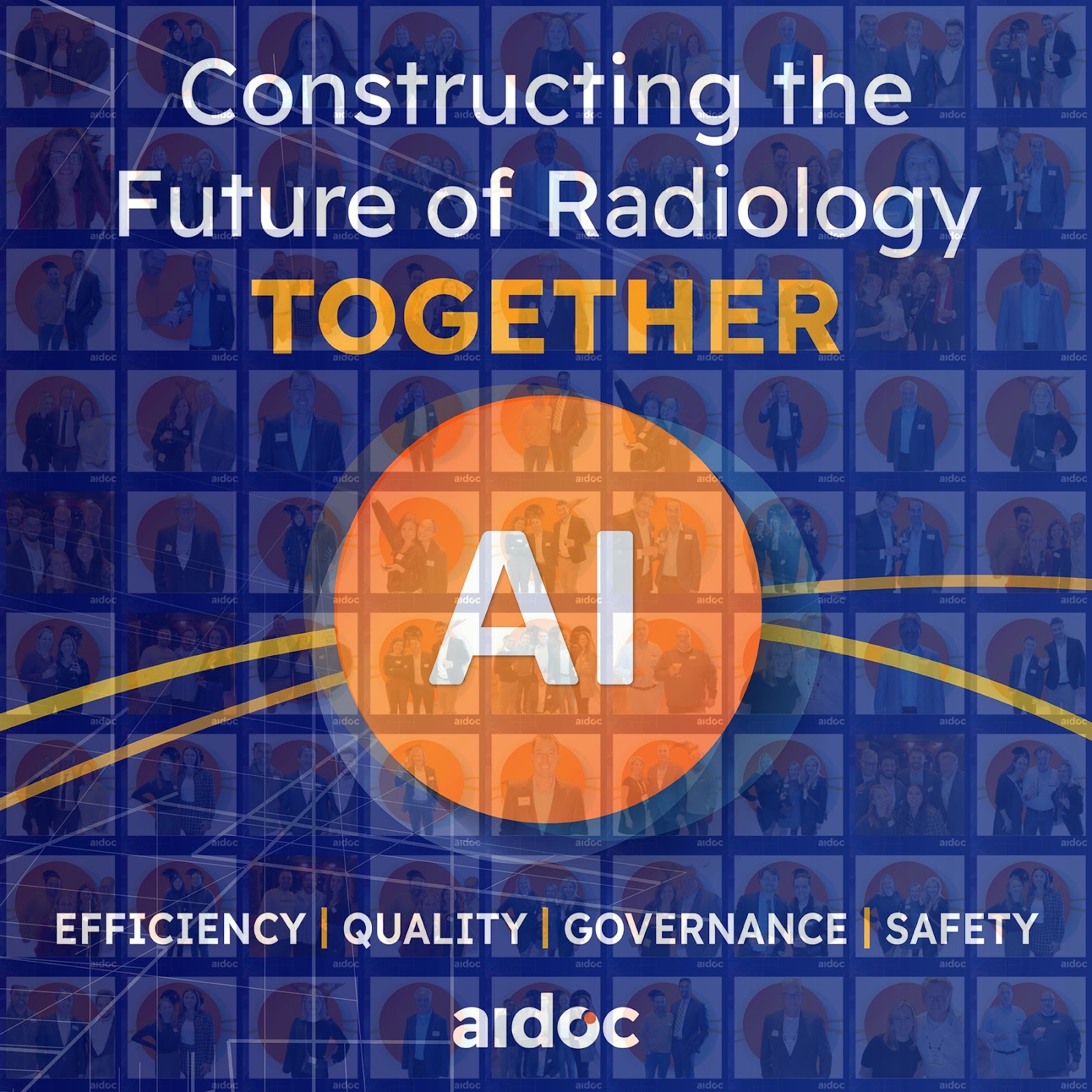
Constructing the Future of Radiology
During our celebration, guests were able to visit our photo booth, snapping pictures which physically became part of our shared vision of a better, brighter future for radiology. Here’s what we built – together.
Jacobs A, et al. From Detection to Revenue: Evaluating the Economic Value of AI-Guided Triage for Incidental Pulmonary Emboli. Presented at: Radiological Society of North America (RSNA) Annual Meeting; Chicago, IL.
Sharma A, et al. Time Saved or Time Spent? Examining Radiologists’ Interpretation Speeds Pre- and Post-AI Triage Implementation. Abstract presented at: Radiological Society of North America (RSNA) 2025 Annual Meeting; Chicago, IL.
Sudanagunta S, et al. Performance Comparison of Two AI-Based ICH Detection Tools on Head CT in a Real-World Clinical Setting. Abstract presented at: Radiological Society of North America (RSNA) 2025 Annual Meeting; Chicago, IL.
Khosla A, et al. Multi-Year Evaluation of an AI-Driven Pulmonary Embolism Response Team (PERT) Care-Coordination Solution at a Large Academic Institution. Abstract presented at: Radiological Society of North America (RSNA) 2025 Annual Meeting; Chicago, IL.