Discover how Aidoc’s AI platform offers seamless end-to-end integration into a facility’s existing IT infrastructure enabling implementation of AI at scale.
Discover how Aidoc’s AI platform offers seamless end-to-end integration into a facility’s existing IT infrastructure enabling implementation of AI at scale.
reif & möller will be the first in Europe to commercially deploy Aidoc's CARE™ Abdomen & Chest CT Triage solutions
Germany’s largest teleradiology network will pioneer the deployment of a first-of-its-kind AI solution from Aidoc that alerts radiologists to multiple acute findings in chest, abdomen, and pelvic CT scans.
NEW YORK — November 25, 2026 – Aidoc, the clinical AI company supporting diagnostic decisions across nearly 2,000 hospitals worldwide, today announced that reif & möller, Germany’s largest teleradiology network, will soon take the next step in its AI journey by deploying the healthcare industry’s first comprehensive AI triage solution.
Aidoc’s CARE™ Abdomen and Chest CT Triage solutions, which received FDA clearance and CE marking (CE0483) earlier this year, will go live at reif & möller in December 2026, starting with a test phase. Together, these solutions, which were built on Aidoc’s CARE™ foundation model, will span 15 new CT triage indications within a single workflow. Alongside four further new AI modules, this will expand reif & möller’s AI-powered capabilities from seven to 26 use cases, providing coverage of time-sensitive pathologies from head to pelvis.
Reporting for more than 140 hospitals across Germany, Austria, Switzerland and Liechtenstein, with more than 70 specialised physicians on duty around the clock, reif & möller operates in a high-volume, time-critical environment. An estimated 90% or more of its work involves emergency cases, which are often complex, with many studies arriving simultaneously.
“We are delighted to be the first European organisation to deploy these new solutions built on Aidoc’s foundation model,” says Dr Torsten B. Möller, CEO of reif & möller. “Expanding our AI capabilities to 26 use cases is particularly exciting because of the nature of our emergency workload. Having AI continuously support our radiologists across a much broader range of acute findings can help us prioritise cases, save valuable time and provide an additional layer of support when every minute matters.”
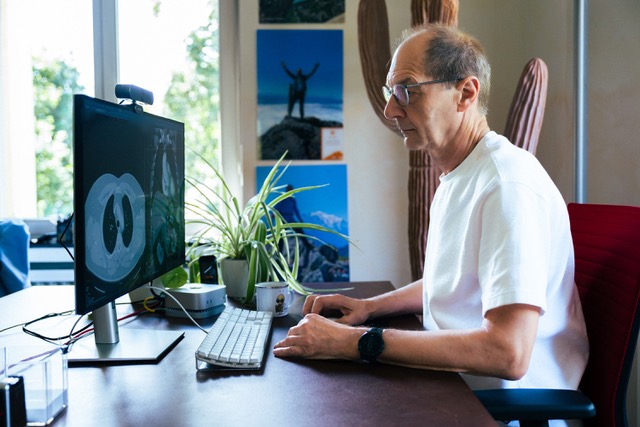
Dr Torsten Möller, CEO of reif & möller, reviewing a CT study
Four years of evidence-led AI adoption
The decision to deploy Aidoc’s CARE™Abdomen and Chest CT Triage solutions is the latest step in a relationship with Aidoc that began in 2022. Since then, reif & möller has progressively expanded its use of AI while evaluating its impact in real-world teleradiology.
Studies presented by Dr Möller at ECR and RSNA, and published in the textbook ‘KI in der Radiologie‘ (AI in Radiology), have demonstrated benefits for both reporting quality and physician wellbeing. In one study, Aidoc’s AI surfaced an additional 5% of intracranial haemorrhage cases*, while the third round of a survey conducted over three years found that 95% of reif & möller’s teleradiologists would not want to work without AI again.1,2,3,4
“We have always wanted to introduce AI in a thoughtful way — not simply because a technology is new, but because it can demonstrate meaningful value in clinical practice,” explains Dr Möller. “The experience and evidence we have built over the past four years have given us confidence to continue expanding where AI can genuinely support our radiologists and patients.”
This evidence has shaped the organisation’s approach: test, measure, learn, and scale technologies that can address real challenges in teleradiology.
“That combination of innovation and evidence has also defined the organisation’s partnership with Aidoc,” says Alexander Böhmcker, VP Europe at Aidoc. “reif & möller has been a true pioneer in clinical AI. What has distinguished their approach is their willingness to innovate alongside a rigorous focus on evidence. They have tested AI in real-world practice, measured its impact, and used what they learned to inform the next stage of their journey.”
The foundation model era
The latest deployment plan marks a new era of AI, made possible by CARE™, Aidoc’s self-developed foundation model, which allows clinical AI to be developed and delivered at scale.
Rather than deploying AI for individual clinical indications, the CARE™Abdomen and Chest CT Triage solutions bring double-digit indications together within a single CT triage workflow. The respective solutions cover 15 indications across contrast and non-contrast CT studies of the chest, abdomen, and pelvis.
The comprehensive abdomen and chest CT triage solutions are delivered through aiOS™, Aidoc’s enterprise AI operating system, providing a single platform for deploying and managing multiple AI use cases. The AI runs continuously in the background, automatically analysing all relevant CT cases, and rapidly alerting radiologists to suspected cases of acute pathologies. The AI supports the radiologists in their work, and every diagnosis is made by a radiologist.
“Foundation models represent an important shift in diagnostic AI,” says Alexander Böhmcker. “Instead of thinking about AI as a collection of individual algorithms, they provide a common foundation from which multiple clinical capabilities can be developed and delivered at scale. This opens the door to a much more comprehensive approach to AI across healthcare.”
For reif & möller, this represents a significant expansion of the role AI can play in its emergency workflow, bringing broader AI support to their radiologists as they manage complex and time-sensitive cases.
Looking ahead: sharing what comes next
As reif & möller begins using the CARE™Abdomen and Chest CT Triage solutions in everyday clinical practice, the organisation will continue to evaluate its impact, building on its track record of generating and sharing real-world evidence on AI in teleradiology.
“As we begin this next phase, we want to continue doing what we have done since 2022: evaluating AI in real-world clinical practice and sharing what we learn,” explains Dr Möller. “We see it as our responsibility as an AI pioneer to contribute evidence that can help the wider teleradiology community understand how these technologies can be used effectively.”
References 1. How do radiologists assess AI support in daily routine? First Germany-wide survey over the course of almost three years, Torsten Bert Thomas Moeller, Dillingen / Germany, ECR 2025: https://connect.myesr.org/course/ai-lightning-talks-11-2/#1 2. AI in routine teleradiology use: results of a large-scale test across Germany and Austria. Torsten Bert Thomas Moeller; Dillingen / Germany, ECR 2024 3. AI in routine use – results of a large-scale test across Germany and Austria, Torsten B. Möller, Dillingen/Saar, Germany: RSNA 2024, Scientific Presentation R3-SSNR16-2, 5 December 2024 4. Möller TB, Engelmann U, Franke DH. KI in der Radiologie [AI in Radiology]. Springer, 2025. ISBN 978-3-662-70339-7
*Further study details: In an offline, retrospective standalone algorithm performance evaluation across the reif & möller teleradiology network, Aidoc’s ICH AI solution was compared to the unaided radiologist on 2,707 non-contrast head CT scans with 7% intracranial haemorrhage (ICH) prevalence. The standalone AI identified approximately 10 ICH cases that the unaided radiologist had missed (enhanced detection rate 5%)
Explore how Aidoc can help increase hospital efficiency, improve outcomes and demonstrate ROI.
Nicola Emery, PhD
Nicola Emery, PhD, is a marketing expert with experience in the pharmaceutical, life sciences and technology sectors. With a strong scientific background, she brings a data-driven, analytical and creative approach to her role as Director of Marketing, Europe.