Discover how Aidoc’s AI platform offers seamless end-to-end integration into a facility’s existing IT infrastructure enabling implementation of AI at scale.
Discover how Aidoc’s AI platform offers seamless end-to-end integration into a facility’s existing IT infrastructure enabling implementation of AI at scale.
Asklepios Successfully Completes Comprehensive AI Rollout in Radiology: 28 Hospitals Using Aidoc to Support Patient Care
Asklepios Group has successfully completed the group-wide rollout of the Aidoc aiOS™platform. As the first private hospital operator in Germany to implement a centralised AI platform for radiology, Asklepios now uses AI comprehensively across its acute care hospitals. The system is now active at 28 hospital locations and supports medical teams around the clock in analysing X-ray and CT images. Smaller locations and emergency care in particular benefit significantly from the technology, which analyses approximately 35,000 CT and X-ray images monthly across all Asklepios Group locations.
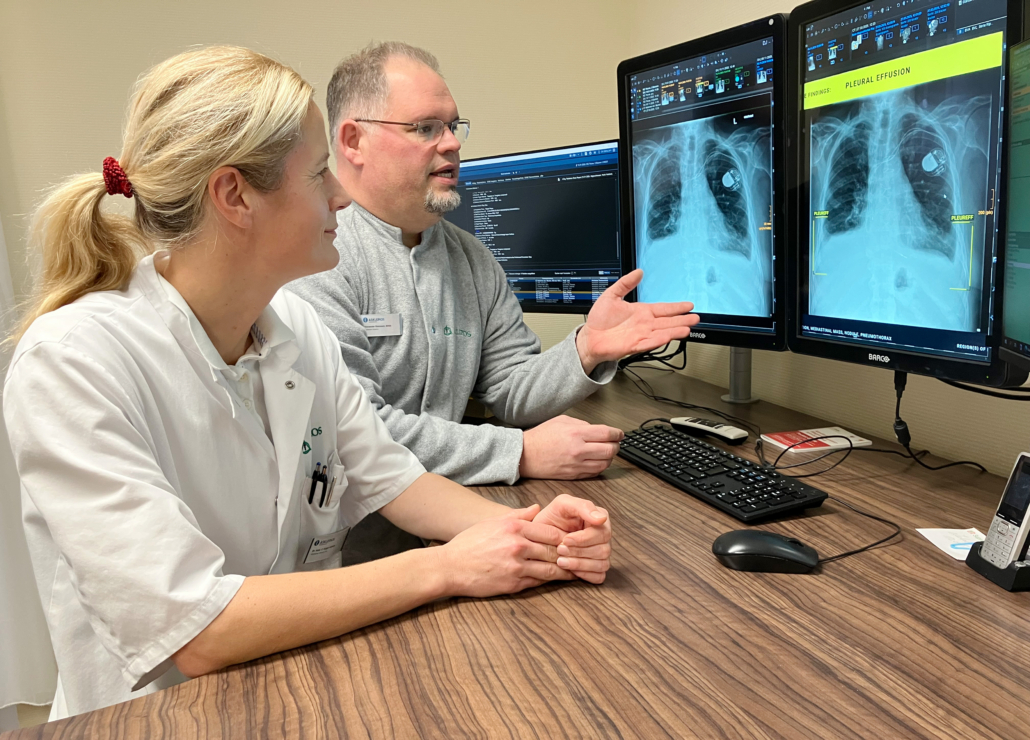
Dr. Claudia Kagel-Hübner, senior physician of the emergency department, and Alexander Steinmetz, chief physician of radiology, use the AI platform at the North Sea Clinic.
Rapid, Scalable AI Deployment
What was announced as an ambitious goal in May 2025 is now a reality: the implementation of Aidoc’s aiOS™ AI platform was completed at the end of 2025. “With the successful rollout at 28 locations, we have kept our promise to bring state-of-the-art technology directly to the patient’s bedside,” says Marco Walker, CEO of Asklepios Group. “We have not only created the technical infrastructure, but sustainably improved the way we diagnose – from metropolitan hospitals to island care.” The implementation of Aidoc is part of Asklepios’s comprehensive digital strategy and is funded by the Hospital Future Act (KHZG).
Part of Asklepios’s Broader Digital Strategy
“The AI project in radiology is the first milestone of the largest digitalisation project at Asklepios: the Health Data Hub, which is currently being developed in five different focus areas and, as the group’s new central analytics platform, will positively transform many work and decision-making processes in daily clinical practice,” explains PD Dr. Sara Sheikhzadeh, Chief Medical Officer (CMO) of Asklepios Group. In the Health Data Hub, Aidoc’s AI software serves as a Clinical Decision Support System (CDSS). The use of AI in radiology supports, for example, prognostic and risk assessments and generates action recommendations. “We relieve our physicians, particularly during night and weekend shifts, while simultaneously increasing patient safety,” says PD Dr. Sheikhzadeh.
Real-Time AI to Support Critical Decision-Making
The technology automatically analyses CT and X-ray images in real time, flagging suspected cases of acute pathologies such as brain hemorrhages, pulmonary embolisms, or fractures. Aidoc’s aiOS, which is built to be scalable and has a straightforward deployment process, analyses more than 35,000 CT and X-ray images monthly across all locations. The implementation follows a secure, cloud-based approach with an on-premises aiOS AI platform, ensuring compliance with strict data security and privacy regulations according to GDPR.
Impact Seen at Busy City Hospitals to Smaller, Regional Sites
However, while large tertiary care centers often stand in the spotlight, the particular value of the AI solution becomes evident precisely at smaller, specialised locations. Asklepios North Sea Clinic Sylt with its associated radiology practice served as an important pilot site. “The software offers us support that runs parallel to the physician’s interpretation and helps bring time-critical findings into focus more quickly,” explains Alexander Steinmetz, Chief of Radiology and Medical Director of Asklepios North Sea Clinic. This is essential especially for an island location like Sylt, which ensures 24/7 basic care provision.
Early Adoption Goes Beyond Radiology
Particular advantages emerge for radiology on-call services, but also for specialists from other disciplines as well as telemedicine connectivity to Hamburg’s Asklepios Altona Hospital:“Prioritisation becomes clearer, cognitive burden decreases, and decisions are made more systematically,” says Steinmetz. Aidoc functions here not as a ‘showcase AI,’ but as an additional safety layer. He confirms a positive response from the team, where the system is perceived as providing relief. This assessment is shared by the Lead Physician of the Emergency Department, Dr. Claudia Kagel-Hübner. Her team, which significantly contributes to the 24/7 basic care provision on Sylt Island, uses the AI results daily. The early piloting at the island hospital demonstrated, according to Steinmetz and Dr. Kagel-Hübner, that even smaller locations are capable not only of accompanying innovative digital health projects, but of actively co-creating them.
Setting a New Standard for Radiology in Germany
“Asklepios is taking a significant step to address the pressing challenges in German radiology. By deploying AI at this scale, they are setting a new standard for how healthcare facilities can leverage technology to increase efficiency and improve patient outcomes – a future-proof solution with sustainable impact,” says Robert Hite, Head of Business Development DACH at Aidoc. “We are proud to support this groundbreaking initiative and contribute to advancing AI-driven transformation in German healthcare.”
Seamless Technical Integration and Project Execution
“The collaboration with Aidoc on technical planning, the integration of AI technology into the daily work routine of our radiology departments, as well as the entire project work is proceeding excellently,” explains Nadine Vermeerbergen, Project Manager at Asklepios IT. “The fact that Aidoc’s AI platform works seamlessly and reliably with our radiological systems was demonstrated to us in the successful pilot,” says Vermeerbergen, who led and implemented the project together with her colleague Eric Sims.
Looking Ahead: A Future of AI-driven Patient Care
With the rollout complete and delivered on-time, Asklepios and Aidoc will continue collaborating on the Health Data Hub and explore further AI-enabled pathways to enhance emergency care, imaging performance and patient treatment across Germany.