14548
Blog

Leading the AI-Powered Hospital: Building a Sustainable, AI-Enabled Workforce

A CEO conversation on resilience, scale and clinical excellence

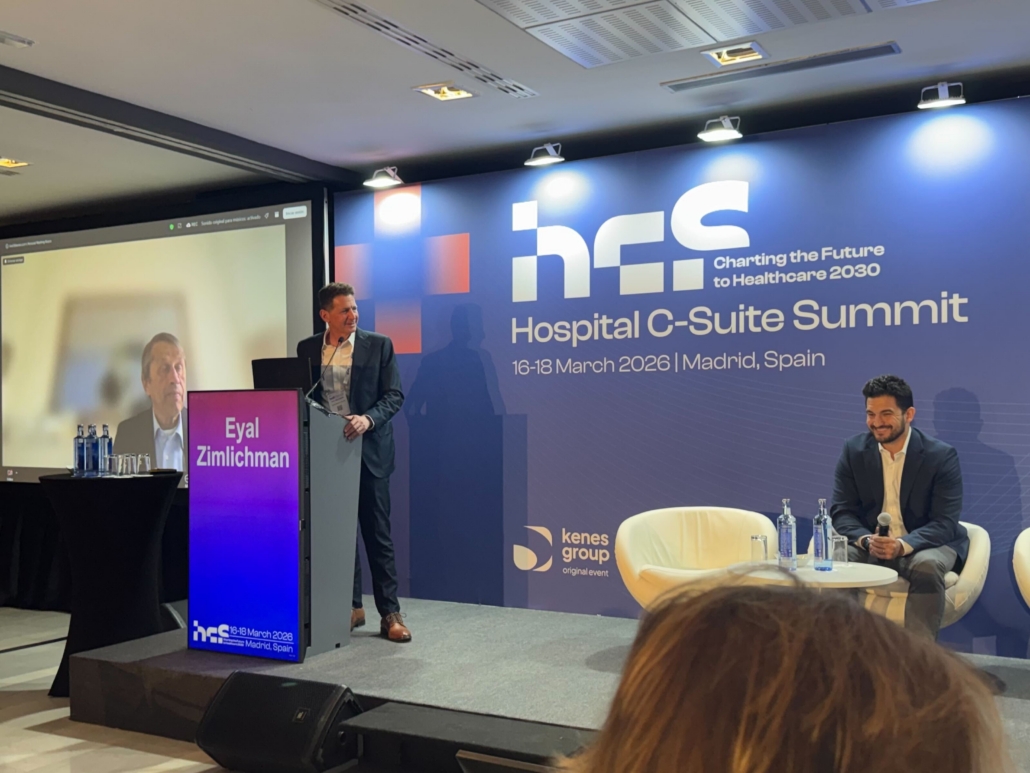
At the recent Healthcare Summit 2026 in Madrid, a panel featuring Aidoc CEO Elad Walach and Charité CEO Prof. Dr. Heyo Kroemer explored a critical question facing healthcare leaders today: how do we move from AI experimentation to real, system-wide transformation?

The conversation, moderated by Prof. Dr. Eyal Zimlichman of Sheba Medical Center, brought together perspectives from both healthcare leadership and AI innovators, highlighting not just the promise of AI, but what it actually takes to make it work at scale.

The Measurable Impact of AI

AI in healthcare is no longer theoretical. In fact, one of the most striking examples discussed came from Sheba Medical Center (Kotovich et. al), where implementing AI computer-aided triage and prioritization software for intracranial hemorrhage (ICH) led to a 30% reduction in mortality

This kind of outcome is rare in healthcare innovation and raises an important question:
If the impact is so significant, why isn’t there universal adoption of AI?

The Barriers to AI Adoption

Despite years of development and over 1,400 FDA-cleared AI solutions, widespread transformation has been slow. According to Elad Walach, two key challenges explain why:

1. Fragmentation and “Pilot-itis”

Healthcare systems have been overwhelmed by narrowly focused tools:

“You had literally hundreds of companies each building a solution to a single disease… who can work with 700 different companies?”

This has resulted in isolated pilots rather than scalable change.

2. The “Last Mile” Problem

Even the best AI models fail without proper implementation:

“It’s a people-process problem first that the AI enables.”

Success depends not just on technology, but on workflow integration, data infrastructure, and change management.

A New Model for AI Implementation

Leading institutions like Charité are taking a different approach. One that prioritises outcomes over tools.

Rather than starting with technology, they began with a clear problem:

  • Improve triage and prioritisation of critical conditions
  • Reduce time to diagnosis and treatment
  • Address workforce shortages (30% of the workforce is retiring in ten years)

From there, they implemented multiple AI solutions in parallel to measure real-world impact before full deployment.

The results were tangible:

  • Notifications led to ~20 additional critical findings identified per month
  • The flags helped cut time to diagnosis and treatment by over half
  • Rapid scaling to 150+ radiology users

Integration Is Everything

One of the clearest themes from the discussion was that AI only works if it fits seamlessly into clinical workflows.

As Eyal Zimlichman noted:

“If you’re going to add something that would add work to your clinicians… it just won’t happen.”

The principle of embedding AI into existing systems rather than disrupting them is a major driver of clinician adoption and long-term success.

The Next Frontier: Foundation Models in Healthcare

Looking ahead, the conversation turned to one of the most exciting developments in the field: diagnostic foundation models.

Unlike traditional AI tools that focus on single conditions, these models can analyse entire scans and provide comprehensive insights.

Aidoc recently received the first FDA clearance for such a model in abdominal CT triage, marking a major shift in what AI can do.

Elad Walach described the potential:

“Imagine a patient coming in… and the physician having access to a model that can look at that image and give them results comprehensively.”

This could fundamentally transform emergency care, triage, and access to diagnostics, especially in the context of global physician shortages.

Leadership in the Age of AI

For hospital leaders, adopting AI is no longer optional, it needs to be strategic.

Prof. Kroemer offered a guiding principle:

“Be at the same time critical and positive… it’s always patient first.”

Elad Walach, meanwhile, emphasised the need for more decisive leadership:

“The CEO sets a strategic direction but actually needs to push the execution as well.”

In an era where innovation must move faster than ever, traditional consensus-driven approaches may not be enough.

From Experimentation to Transformation

The panel made one thing clear: healthcare is at a turning point.

AI has already proven it can help save lives. The challenge now is scaling that impact and moving beyond pilots to fully integrated, system-wide solutions.

The organisations that succeed will be those that:

  • Focus on outcomes, not tools
  • Invest in platforms, not point solutions
  • Prioritise workflow integration
  • Lead with clarity and urgency

As AI continues to evolve, the question is no longer if it will transform healthcare, but who will lead that transformation.

The leadership panel at HCS 2026 (left to right): Prof. Dr. Heyo Kroemer, CEO Charité; Prof. Dr. Eyal Zimlichman, Chief Transformation, Innovation and Al Officer at Sheba Medical Center, Director and Founder of ARC Innovation, Future of Health (FOH) Co-Chairman; Elad Walach, CEO Aidoc.

Explore the Latest AI Insights, Trends and Research

Alexander Boehmcker
Alexander Boehmcker is the Vice President, Europe at Aidoc. Prior to Aidoc, he spent more than a decade as the CEO of Telemedicine Clinic (TMC), a pioneering healthcare start-up that scaled into one of Europe’s largest and most respected imaging diagnostic groups. After a successful integration of TMC into Unilabs, Boehmcker founded his company, Boehmcker Consulting, which focuses on digital healthcare and sustainability. He believes that both AI technology in healthcare as well as sustainable forestry can help to address significant challenges of humanity in the future. Boehmcker is co-founder of the Spanish chapter of Conscious Capitalism. He holds an lic.oec. from the University of St. Gallen and an MBA (CEMS) from ESADE.
Alexander Boehmcker
Vice President, Europe